
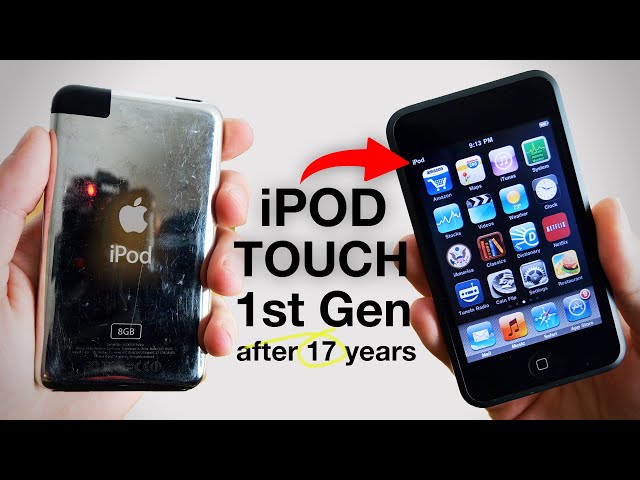
I spent three hours Sunday morning hunting for a 30-pin cable. You remember those. The wide, annoying Apple connectors with the little clips that preceded Lightning. I finally found one buried in a plastic bin of old hard drives, plugged it into a first-generation iPod Touch I bought on eBay for $42, and waited.
It booted up. The battery somehow held a charge. iPhone OS 3.1.3.
The screen is tiny. Just 3.5 inches across. Holding it feels weirdly dense compared to the massive, hollow-feeling slabs of glass we carry today. Sliding to unlock that pixelated screen hit me with a wave of pure tech optimism I haven’t felt in a long time. And no notifications. No algorithmic feeds screaming for attention. Just a grid of static, heavily skeuomorphic icons and a dedicated music player.
The Syncing Nightmare
Getting music onto this aluminum brick in 2026 is an absolute nightmare. The App Store is completely dead for this firmware. You can’t just download Spotify or Apple Music. It requires local files.
I assumed I could just plug it into my current M3 Mac and drag files over via Finder. Nope. It threw a vague connection error immediately. Well, that’s not entirely accurate — modern macOS doesn’t really know what to do with a device running an OS from the Bush administration. I ended up having to spin up an old Mac Mini I keep around for legacy software, running macOS Mojave 10.14.6, just to get a native version of iTunes that would reliably sync local MP3s.
I ripped a stack of old CDs I had in a closet, synced them over the painfully slow USB 2.0 connection, and plugged in a pair of wired IEMs.
The audio quality actually holds up. Early Apple devices had surprisingly good internal audio hardware before everything shifted to wireless compression. It sounds warmer and punchier than the Bluetooth audio I usually stream. But the audio fidelity isn’t really the point.
The Accidental Dumbphone

Apple officially killed the iPod line back in May 2022 when they discontinued the 7th-generation Touch. At the time, the tech press nodded in agreement. The iPhone ate the iPod. Why carry two devices when one does everything?
But, you know, four years later, carrying two devices is exactly why the vintage tech market is blowing up. People are paying premium prices for dedicated audio players just to escape their primary screens. As reported by The Verge, “The iPod’s demise marks the end of an era where portable music players were a must-have gadget.”
I took the iPod on a run yesterday. For the first time in months, I wasn’t interrupted by a Slack ping, an email vibration, or a spam call. Just me, a 19-year-old piece of hardware, and an offline playlist.
The best part is that the device is completely broken for anything other than its core function. Try loading a website on this version of Mobile Safari today — you can’t. Almost every modern site uses HTTPS with TLS certificates that this old WebKit engine simply doesn’t understand. It fails instantly. You can’t check Twitter. You can’t read the news. The Wi-Fi chip is basically useless unless you’re trying to sync a local clock.
Which, in a way, makes it the perfect focus tool. We spent the last two decades building devices that can do absolutely everything, and now we’re desperately looking for hardware that only does one thing. You can buy a modern dedicated audio player for $400, or you can dig through a drawer and resurrect a piece of consumer tech history, as The Verge recently explored.
I think I’ll stick with the iPod. Probably until the battery inevitably swells up and cracks the screen.